Is Australia’s housing market crashing or correcting?
National values are falling, but a correction is not a crash. Here’s what the August 2026 data shows and what it means for buyers.


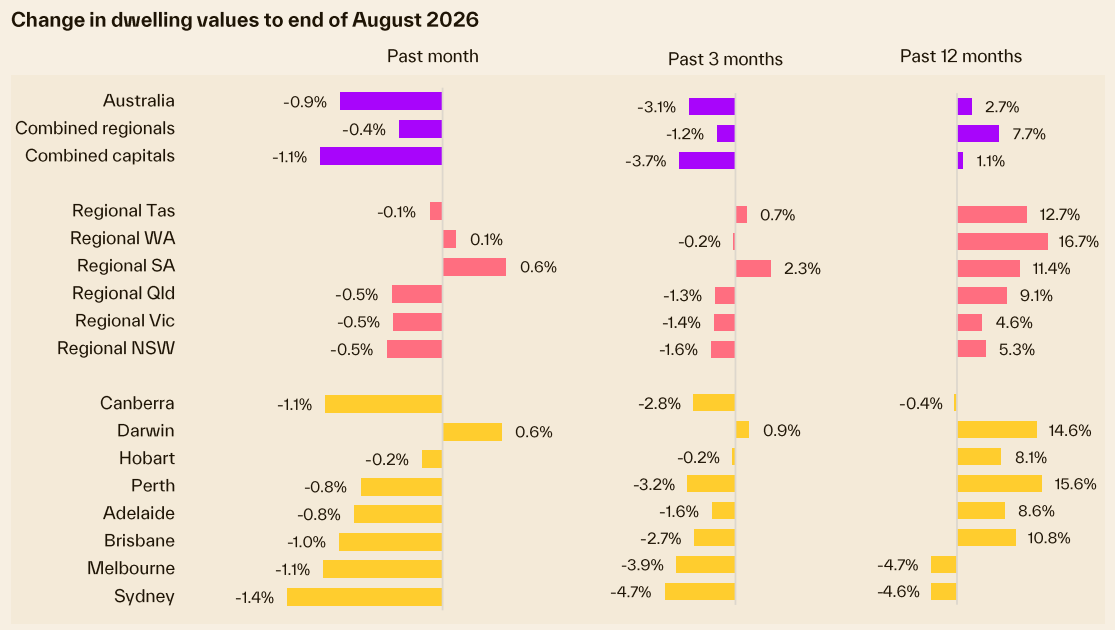
The short answer: Australia's housing market is falling, but the evidence so far points to a correction, not a crash. National dwelling values fell 3.1% in the three months to August 2026. The conditions that usually come with a crash, such as rapidly rising unemployment and widespread mortgage defaults, are not showing up.
Key points
- National dwelling values fell 3.1% over the three months to August 2026.
- 93% of capital city suburbs recorded falling values over winter, up from 45.8% in autumn.
- Sydney fell the most, down 4.7%. Darwin rose 0.9%.
- Houses are falling faster than units.
- Buyers have more choice and more room to negotiate.
- Borrowing capacity, not price, is still the main limit for many buyers.
How much have Australian property prices fallen?
Australia's housing downturn gathered pace over winter. National dwelling values fell 3.1% over the three months to August 2026, according to Cotality. Every capital city except Darwin recorded a decline.
The falls have also spread. 93% of capital city suburbs recorded falling values over winter. That is more than double the 45.8% recorded in autumn.
What's the difference between a correction and a crash?
There's no official line between the two. In general:
- A correction is a modest fall in values as the market adjusts after a period of growth.
- A crash is much bigger. It usually means large, sustained falls driven by a major economic or financial shock, such as rapidly rising unemployment, widespread mortgage defaults or a credit crisis.
Is the Australian housing market going to crash?
So far, the evidence points more to a correction than a crash. No one can say for certain where the market goes next.
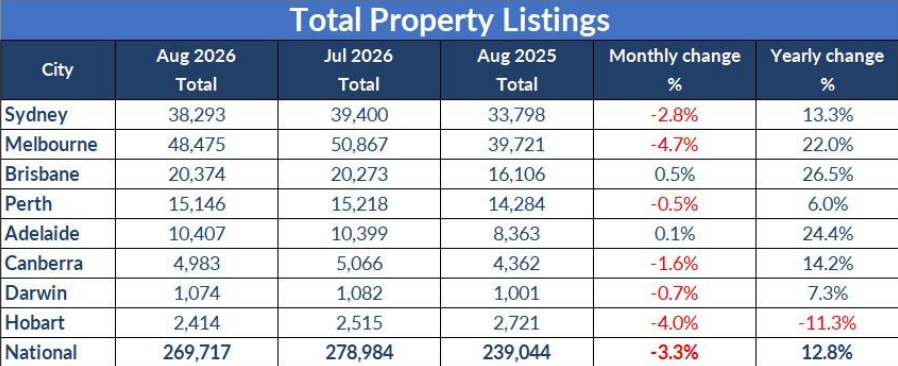
Buyer demand has clearly weakened. Cotality estimates home sales over the latest quarter were 15.5% lower than at the same time last year, and 11.5% below the five-year average. Listings are also higher than a year ago in every capital city except Hobart, according to SQM Research.
But some of the conditions that usually come with a crash are not there:
- Jobs: the labour market is still supporting the housing market, although conditions are gradually loosening. Steady employment helps limit forced sales and arrears.
- Supply: new housing supply is still short of underlying demand. Construction costs and capacity limits slow how quickly new homes can be built.
Which cities are falling the most?
There isn't one Australian property market. The national figure shows the direction, but cities, suburbs and property types are moving at very different speeds.
Houses and units are also moving at different speeds. The gap is widest in Sydney and Melbourne.
The differences can be even bigger at suburb level. Local supply, the types of property for sale and the number of active buyers all affect prices.
National headlines describe a direction. They don't describe your market, your price point or the property you want to buy.
What does a softer market mean for buyers?
Softer conditions can create opportunities that weren't there when competition was stronger. Homes are taking longer to sell, and vendors are offering bigger discounts. The median vendor discount nationally was 3.8% in the three months to July 2026, up from 3.4% a year earlier, according to Cotality.
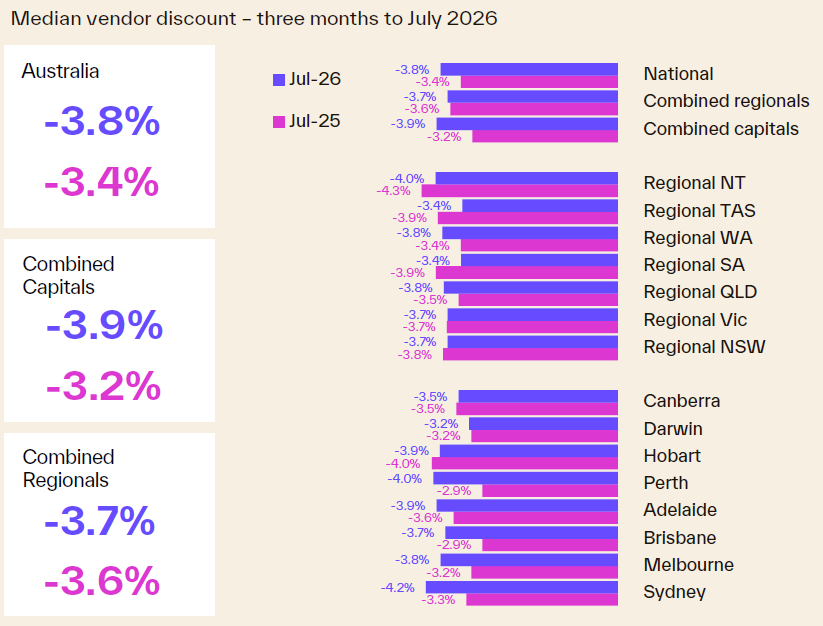
In practice, buyers now generally have more choice, less urgency and more room to negotiate.
But softer prices don't automatically make buying easier. Mortgage rates are high, and lenders' serviceability requirements still limit how much people can borrow. For self-employed borrowers and investors with more complex finances, the choice of lender matters even more. Different lenders can assess the same financial position very differently.
How should you make a property decision right now?
Base it on your own position, not the headlines. No buyer can control whether the downturn deepens or levels out. What you can control is how prepared you are for the market you actually face. That means:
- Understanding your borrowing capacity at current interest rates.
- Knowing how different lenders will assess your income and commitments.
- Thinking about how the loan will work alongside your broader plans.
Sources: Cotality Home Value Index, September 2026 release (figures to 31 August 2026). SQM Research, total property listings, August 2026. Cotality, median vendor discount, three months to July 2026.
Questions we're getting asked
Are house prices falling in Australia?
Yes. National dwelling values fell 3.1% in the three months to August 2026, and every capital city except Darwin recorded a decline, according to Cotality.
Is Australia in a housing crash?
Not on current evidence. The falls are spreading, but crash conditions such as rapidly rising unemployment and widespread mortgage defaults are not present. It looks more like a correction.
Which Australian city has fallen the most?
Sydney. Values fell 4.7% over the three months to August 2026, and Sydney houses fell 5.4%.
Are houses or units falling faster?
Houses. Nationally, house values fell 3.3% over the three months to August 2026, compared with 2.2% for units.
Do all lenders assess borrowing capacity the same way?
No. Each lender has its own serviceability policy. Two lenders can look at the same income and debts and arrive at different borrowing amounts.
This article is general information only. It does not take into account your personal objectives, financial situation or needs, and it is not financial, tax or legal advice. Speak to your accountant or licensed adviser about your own situation before acting.
Get honest home loan help.
The right loan, a better rate, honest answers — it all starts with a chat. No pressure. Just real good advice, tailored to you.
