Same couple, same income, half the borrowing power
The rules changed on 26 June, not just the rates. Here is what it did to one real scenario, and why the answer now depends entirely on which lender you use.

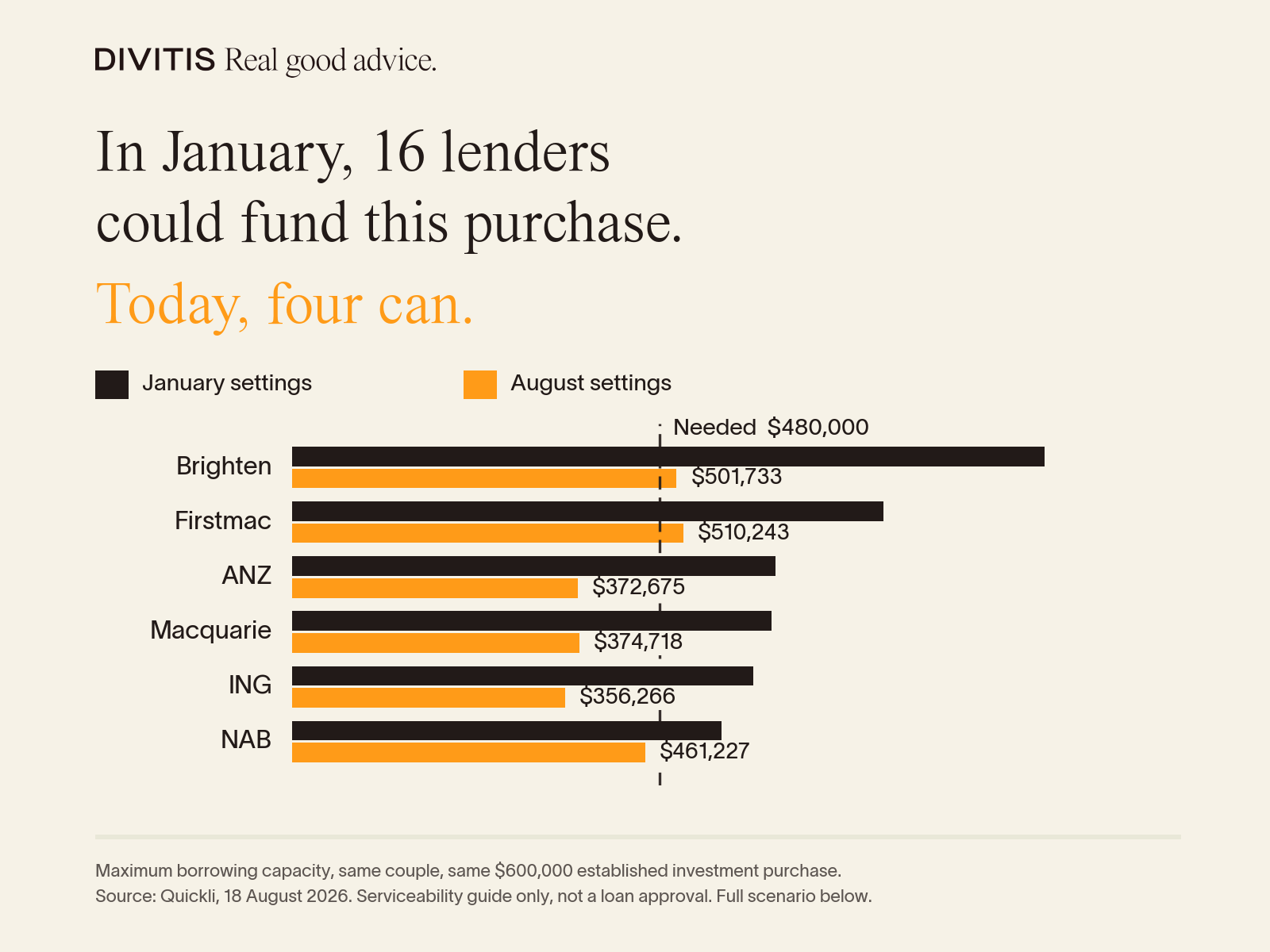
In January, a couple on a combined $200,000 could have bought this investment property with almost any lender on our panel. Today, four can.
Here is the file. Two PAYG incomes, $110,000 and $90,000. One dependent. An existing owner occupied mortgage of $700,000. They want a $600,000 established investment property with a 20% deposit, so a $480,000 loan, with rent of $500 a week.
We ran it twice through the same servicing software on the same day. Once at January settings, meaning rates 0.75% lower and negative gearing available. Once at August settings, meaning current rates with negative gearing removed, which is where an established purchase now sits.
At January settings, 16 of the 19 lenders that returned a result could fund it.
At August settings, four could. Three of those four are non-bank lenders. The fourth is a mutual bank, and it clears by $90 a month.
Not one major bank makes it.
Two things changed, and only one of them was rates
The RBA lifted the cash rate three times in the first half of 2026, in February, March and May, from 3.60% to 4.35%. It has held at 4.35% since, including at the August meeting. On this file, product rates moved about 0.75%. Because lenders assess you above your actual rate, every one of those increases lands with a multiplier.
The second change is bigger, and most buyers have not connected it to their loan yet.
The Treasury Laws Amendment (Tax Reform No. 1) Act 2026 received Royal Assent on 26 June 2026. From 1 July 2027, rental losses on an established residential investment property bought after 7:30pm on 12 May 2026 can only be offset against residential rental income or capital gains from residential property. Not against your salary. New builds keep negative gearing. Anything you held, or had under contract, before that date is grandfathered and untouched.
Lenders assess a loan over thirty years, not over the ten months until the rules bite. The servicing calculators have already moved.
The lenders did not move together, and that is the whole point
Look at the two major banks in the table. ANZ fell 41%. NAB fell 18%. Same tier, same rate movement, same borrower, same file.
The explanation is not complicated. A lender that was already conservative about how much of the negative gearing benefit it counted had less to give up when the benefit went. The lenders that were most generous in January have fallen the furthest. Brighten topped the January list at $982,123 and lost close to half of it.
That has a practical consequence for anyone who was in the market earlier this year.
Most pre-approvals run for 90 days. A January approval expired in April. A May approval is expiring around now. So nobody is walking around with a stale number. What they have is no approval at all, and a renewal that gets assessed from scratch under the current rules. If that approval came from the most generous lender on the panel, the renewal is where the fall lands hardest.
The tax side is worse again, because it is decided by your contract date, not your approval date. Anything you had settled or under contract before 7:30pm on 12 May 2026 is grandfathered and keeps the old rules for as long as you hold it. Being pre-approved and still looking on that date counts for nothing.
So a buyer who was approved in April, spent the winter searching and signs a contract on an established property next month takes the new servicing treatment and the new tax treatment. They missed the cut off by a few weeks, and most of them do not know it yet.
If you were pre-approved earlier this year and you are still looking, get the number re-run before you bid on anything.
The assessment rate column nobody looks at
There is a second reason the results split the way they did, and it is visible in the last column of the table.
Lenders regulated by APRA must assess you at 3 percentage points above the actual rate on the loan. That buffer has been at 3 points since October 2021 and APRA confirmed in June 2026 that it stays there. So on a 6.46% loan, ANZ has to be satisfied you could pay at 9.46%.
Non-bank lenders are not authorised deposit taking institutions and are not bound by that rule. Brighten and Firstmac assessed the same file at 2 percentage points over. On a $480,000 loan, one percentage point of assessment rate is the difference between a deal that works and a deal that does not.
That is not a loophole and it is not free. Non-bank rates on this file were higher, 6.74% and 7.04% against ANZ at 6.46%. You are paying more in return for being assessed on a more realistic number. Whether that trade is worth it depends entirely on what you are trying to do, and it is a conversation worth having properly rather than assuming the cheapest advertised rate is the right answer.
Where the market actually sits
The lending picture has tightened at the same time as values have softened, which is why so many buyers feel like the maths has stopped working.
Cotality's Home Value Index for July 2026 recorded a 0.7% fall in national dwelling values over the month, the largest single month decline since December 2022. Sydney fell 1.4% and Melbourne 1.2%. The downturn has now reached markets that were holding up, with Brisbane down 0.6% and Adelaide down 0.2%.
Total listings across the combined capitals sit 5.7% above the five year average, and finalised auction clearance rates have held below 50% since late May. Worth being straight about the other side of that. Nationally, total listings are still slightly below the five year average, so stock has not blown out everywhere. But in Sydney and Melbourne, which account for around four in five auctions, urgency has clearly eased.
Supply is not improving either. Australia approved 205,249 new dwellings in the 2025 to 2026 financial year, the strongest annual result in five years, and still short of the 240,000 a year the National Housing Accord requires to reach 1.2 million homes by June 2029. Completions, which are what the target actually measures, are further behind again.
So values are softer, and the structural shortage has not gone anywhere.
What to do about it
The old advice was to work out what you can afford and then go looking. That still holds. What has changed is that the answer now varies enormously depending on which lender the application goes to.
Three things worth sorting before you make an offer.
Get a current borrowing capacity, not one from earlier this year. If your pre-approval was issued before June, treat the number on it as out of date.
Understand whether the property you are looking at is established or a new build, because that single distinction now changes both your tax position and your borrowing capacity. If a new build is a genuine option for you, run both scenarios before you choose.
Get the lender choice right the first time. On this scenario, the spread between the best and worst result was over $150,000 of borrowing capacity on identical inputs. Applying to the wrong lender does not just get you a no. It puts a credit enquiry on your file and costs you weeks.
None of this is about predicting where prices go. It is about knowing your own position accurately enough to move when something suits you.
Your lender may not be one of the six above. And even if it is, these figures belong to one couple with one set of numbers, so they will not be your numbers.
Both of those are quick to fix. Tell us who you are with now, and whether you are looking at an established property or a new build, and we will run your actual position across the panel.
Whether that is an investment purchase or you are self-employed and the numbers have stopped stacking up the way they used to, get in touch with the team at Divitis Finance. We will tell you where you actually stand.
Questions we're getting asked
Can I still negatively gear an investment property in 2026?
It depends on what you buy and when you bought it. Anything you held before 7:30pm on 12 May 2026 is grandfathered and unaffected. New builds keep negative gearing. For an established property bought after that date, from 1 July 2027 rental losses can only be offset against residential rental income or capital gains from residential property, not against your salary.
Does the negative gearing change affect the property I already own?
No. If you owned it, or were under contract, before 7:30pm on 12 May 2026, nothing changes. Your losses stay deductible against your salary for as long as you hold the property. The change only applies to established residential property bought after that date.
My pre-approval expired. Will I get the same amount again?
Probably not, if you are buying an established investment property. Most pre-approvals run 90 days, so anything issued in the first half of 2026 has lapsed. The renewal is assessed at today's rates and, on an established purchase, without the negative gearing benefit. On one scenario we ran, the same couple went from 16 lenders able to fund the purchase down to four.
What is the APRA serviceability buffer?
It is a stress test. Lenders regulated by APRA must check you could still afford the repayments at 3 percentage points above your actual rate. On a 6.4% loan, you are assessed at 9.4%. It has sat at 3 points since October 2021 and APRA confirmed in June 2026 that it stays. Non-bank lenders are not bound by it and commonly assess at 2 points.
Can I still buy an investment property if the banks say no?
Often, yes. The answer now depends heavily on which lender the application goes to. On the scenario we ran, every major bank fell short while three non-bank lenders and one mutual bank cleared it. Same borrower, same income, same purchase. Getting a no from one lender is not the same as the deal not working.
This article is general information only. It does not take into account your personal objectives, financial situation or needs, and it is not financial, tax or legal advice. Speak to your accountant or licensed adviser about your own situation before acting.
Get honest home loan help.
The right loan, a better rate, honest answers — it all starts with a chat. No pressure. Just real good advice, tailored to you.
