Nearly 6% of new mortgages are being approved outside standard serviceability policy
APRA data shows 5.8% of new home loans were approved outside standard servicing rules. Here's what that means if one lender has declined or capped you.

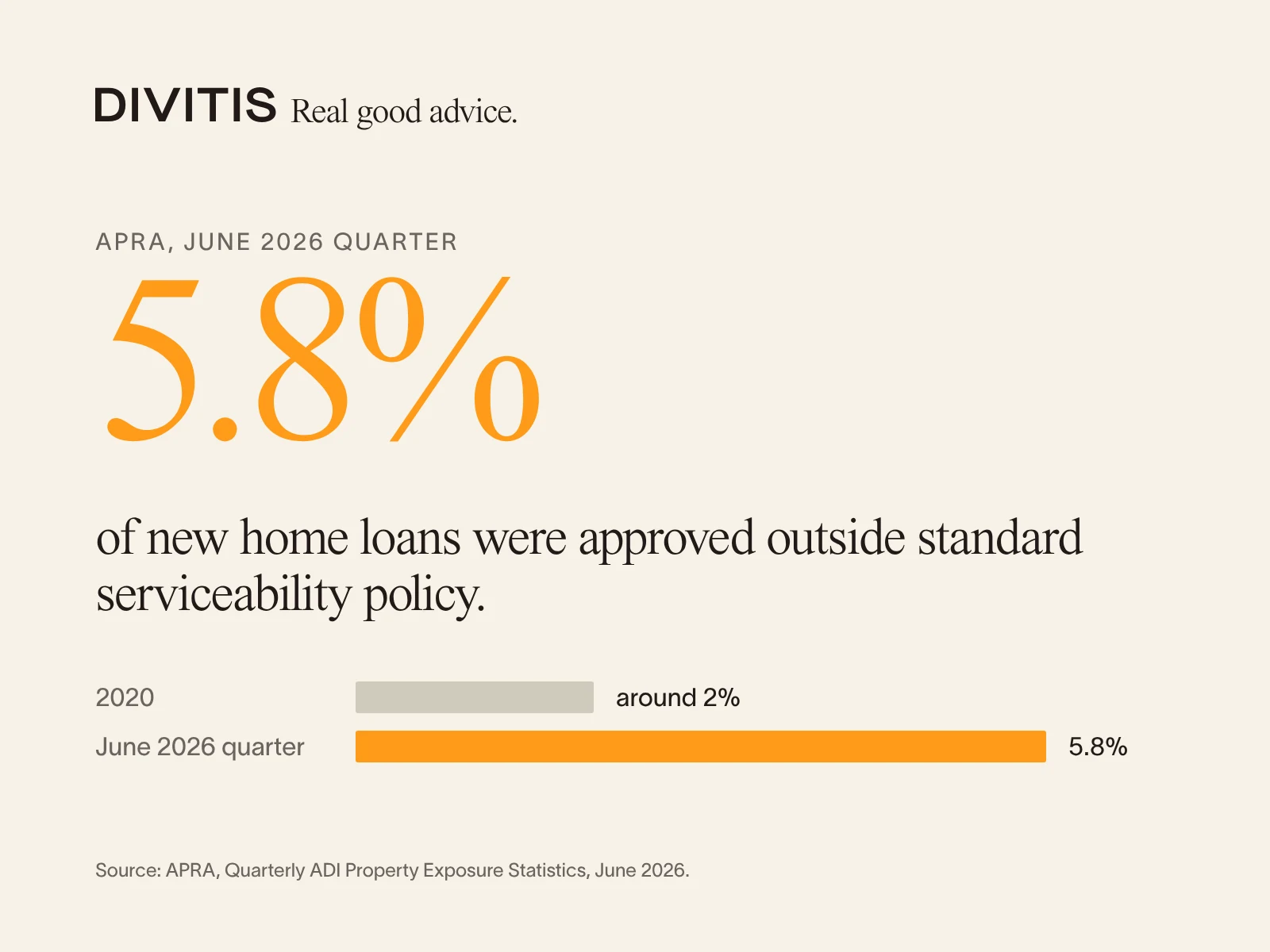
The short answer: A serviceability exception is when a lender approves a home loan that falls outside its standard servicing rules. They are becoming more common. APRA data shows 5.8% of new housing loans funded in the June 2026 quarter were approved as exceptions, up from around 2% in 2020. For self-employed borrowers and investors, being declined or capped by one lender is not always the final word.
Key points
- 5.8% of new housing loans in the June 2026 quarter were serviceability exceptions, up from around 2% in 2020.
- An exception is not a way around responsible lending. Banks must still be satisfied you can repay.
- Lenders can consider other evidence, such as a temporary dip in income or a repayment history when refinancing.
- Self-employed income and complex investor portfolios are often treated differently from one lender to the next.
- A decline from one lender doesn't settle what the wider market might do.
What is a serviceability exception?
When a lender assesses a home loan, it checks whether you have enough income to meet the repayments after living expenses and other debts. This is called serviceability.
APRA also requires banks to test new borrowers at an interest rate at least 3 percentage points above the actual loan rate. This serviceability buffer leaves room for future shocks, such as higher rates, lower income or bigger expenses.
A serviceability exception is when a bank approves a loan that falls outside its normal servicing criteria. APRA's definition covers:
- loans approved below the lender's minimum serviceability threshold
- loans where servicing inputs were adjusted outside standard policy
- loans where extra income outside normal policy was included.
An exception is not an exemption from responsible lending, and it isn't an automatic way around the buffer. Banks must still make a prudent assessment of whether the borrower can repay. APRA expects exceptions to be limited, justified and appropriately managed.
How common are serviceability exceptions?
More common than they were. APRA data shows 5.8% of new housing loans funded in the June 2026 quarter were approved as exceptions to lenders' standard serviceability policies. In 2020 it was around 2%.
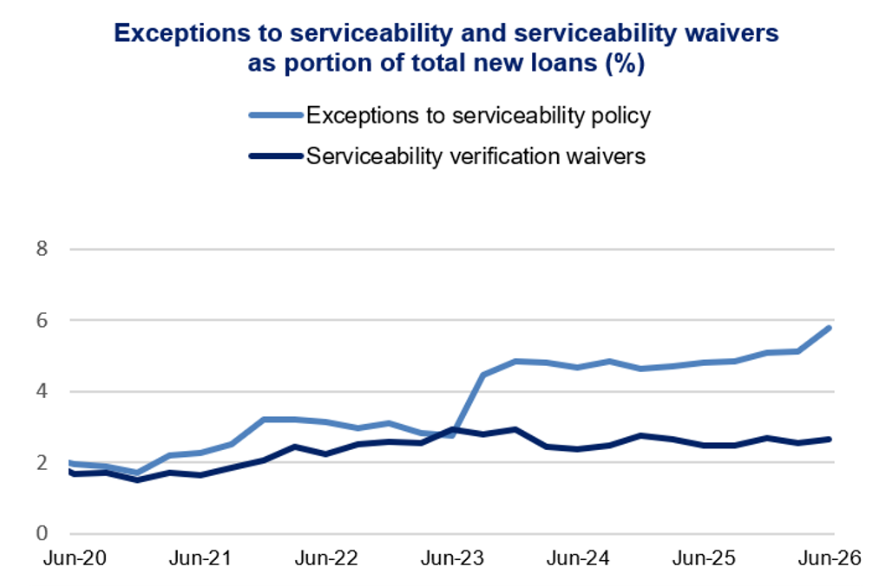
That doesn't mean lenders are dropping their credit standards. It shows that the standard servicing calculation isn't always the final word on whether a borrower can support a loan.
Why might a lender approve a loan outside standard policy?
Standard servicing models are built to work consistently across large numbers of borrowers. The trade-off is that they don't always capture the full picture for a more complex applicant.
Lenders can consider other signs that a borrower can repay. For example:
- Temporarily low income: a lender may look past a period of lower income where there is good evidence it will recover.
- Refinancing: a borrower's actual repayment history may form part of the assessment.
- Bridging finance: a short-term servicing shortfall while moving between properties.
- Other income: income that falls outside a lender's usual calculations.
Why does this matter for self-employed borrowers and investors?
Business owners may have retained profits, variable earnings, distributions or other income that lenders don't all treat the same way. Property investors can face a similar problem when several loans, rental income and existing debts go into a lender's servicing model.
Do all lenders assess borrowing capacity the same way?
No. Serviceability policy is lender-specific. Two lenders can assess the same financial position and arrive at different borrowing capacities, because they use different assumptions about income, expenses and existing debt. Their appetite for policy exceptions, and how they consider them, can also differ.
Non-bank lenders are not bound by APRA's serviceability buffer, and some set their own.
So a decline from one lender, or being told you've reached your maximum, doesn't automatically show how much you can borrow across the wider market.
What should you do if you've been declined or capped?
Don't simply send the same application to another lender. Start by understanding:
- What is limiting your borrowing capacity.
- How different lenders are likely to treat your income and debts.
- Whether there is a genuine basis for an exception.
At Divitis Finance, we work with self-employed borrowers and investors whose finances don't always fit neatly into standard lending models. We can help you understand how different lenders may assess your situation. If you've been declined or capped by a lender, or expect your application to sit outside standard policy, book a chat with the team.
Sources: APRA, Quarterly ADI Property Exposure Statistics, June 2026 (published 17 September 2026). APRA, update on macroprudential settings (serviceability buffer).
Any discussion of borrowing capacity is a guide only. No loan approval can be assumed, and every application is subject to the individual lender's credit criteria.
Questions we're getting asked
What is a serviceability exception?
A loan a lender approves even though it falls outside its standard servicing rules. The lender must still be satisfied that the borrower can repay.
How many home loans are approved as serviceability exceptions?
5.8% of new housing loans funded in the June 2026 quarter, up from around 2% in 2020, according to APRA.
What is the serviceability buffer?
APRA requires banks to assess new borrowers at an interest rate at least 3 percentage points above the actual loan rate.
Can I still get a home loan if one bank has declined me?
Possibly. Each lender has its own policy, so a decline from one doesn't automatically decide the outcome elsewhere. Any approval depends on the lender's credit criteria.
Are non-bank lenders bound by the APRA buffer?
No. Non-bank lenders aren't bound by APRA's serviceability buffer, although some apply their own.
This article is general information only. It does not take into account your personal objectives, financial situation or needs, and it is not financial, tax or legal advice. Speak to your accountant or licensed adviser about your own situation before acting.
Get honest home loan help.
The right loan, a better rate, honest answers — it all starts with a chat. No pressure. Just real good advice, tailored to you.
